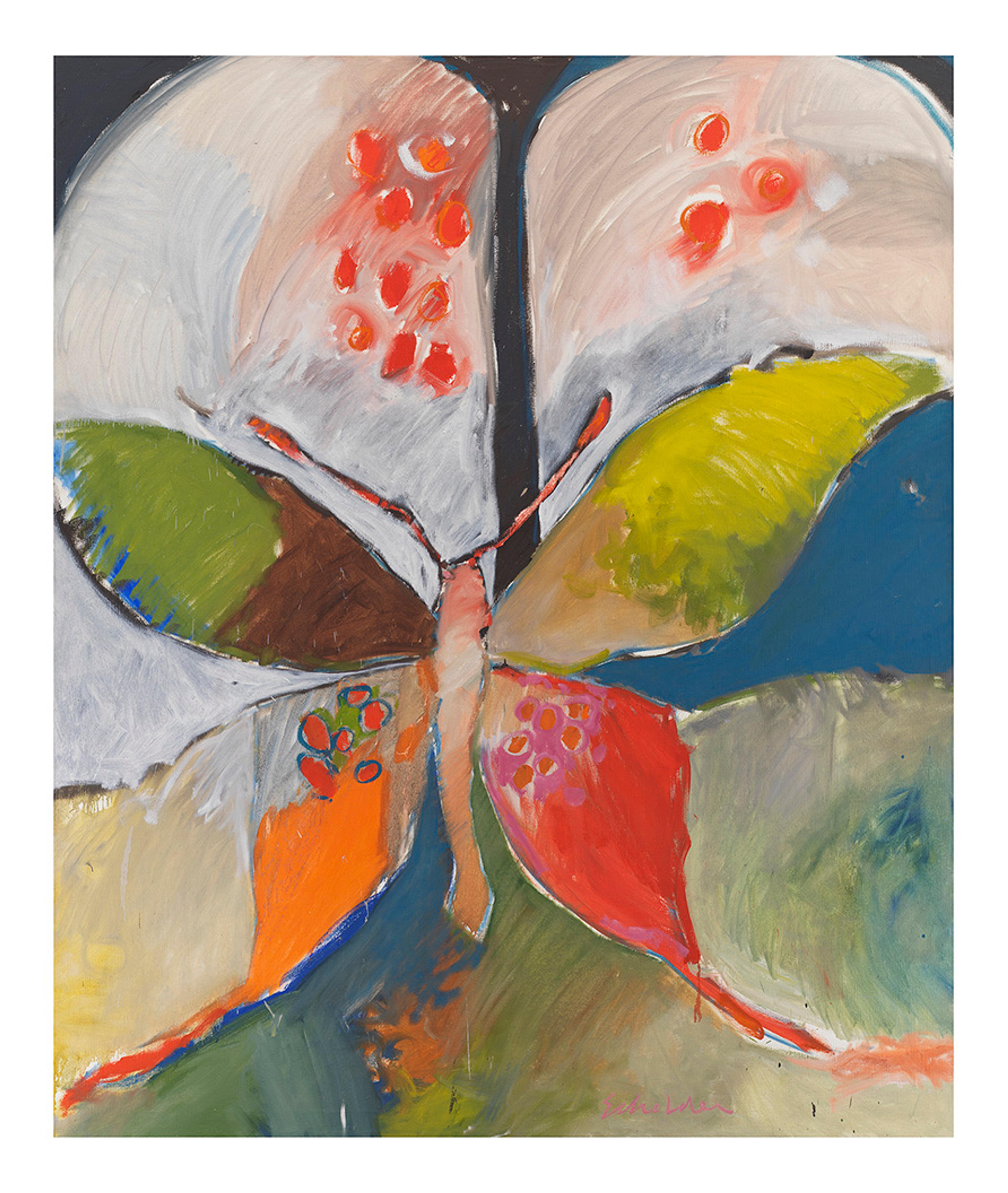
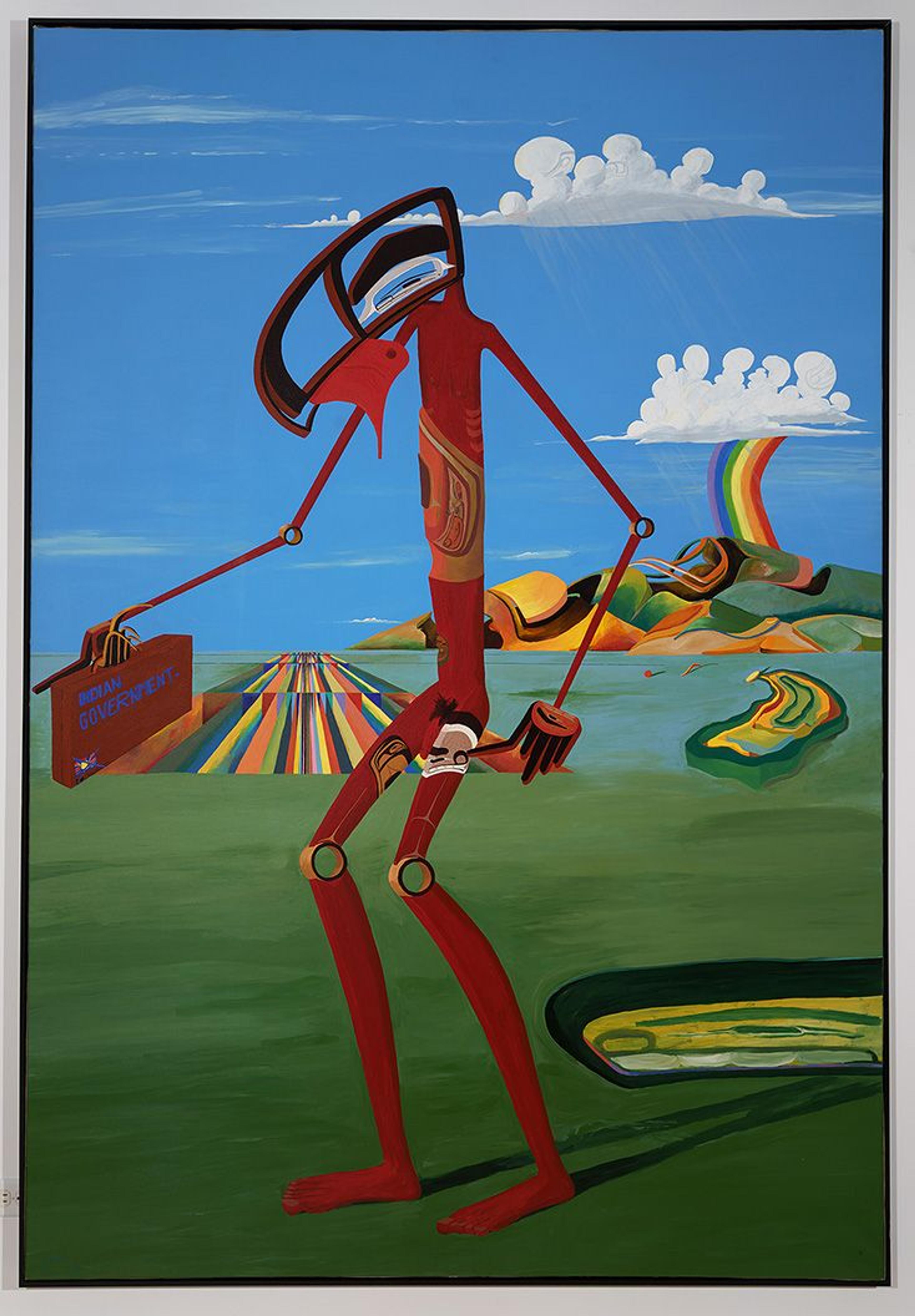
Lawrence Paul YuxweluptunLeaving My Reservation to Go to Ottawa and Fight for a New Constitution
The work of Susan Hudson (Navajo/Diné) addresses contemporary topics of social and political relevance through quilting, an art form taught to the artist by her mother. You Are Not the Problem, The Homophobes Are explicitly foregrounds the plight of Indigenous peoples in their fight for the right to self-determination, particularly the rights of those persecuted by homophobia, a stance which contradicts traditional attitudes that afford space and honor to those who do not adhere to colonial binaries of gender and sexuality. The work literally threads together the history of oppression suffered by Indigenous communities and the harassment endured to this day by people who refuse settler conformity.
Susan Hudson
84 x 48 1/2 in.
Art Bridges
2023
Quilted textile
AB.2025.30
Pending
Susan Hudson Transcript
February 16, 2026
Participants: Susan Hudson (SH), Artist; Sarah Myers (SM), Associate Curator, Interpretation; Ibby Ouweleen (IO), Curatorial Associate
The artist, Susan Hudson, has asked that this interview be shared with the following warning: The discussion below involves topics, events, themes, and imagery that may be distressing, including sexual assault, gender violence, murder, displacement, and forced assimilation.
SM: A lot of your work deals with traumatic topics. We want to be sensitive to that. Please share as much or as little as you want. We appreciate anything we can learn from you today. Let’s start with who you are—and what you want to share of your story and your background—before we get into more specific questions about your work.
SH: Okay, so I always give a warning because some of the things I talk about can trigger people if they have PTSD or if something is currently happening to them.
I am based in New Mexico and the great Navajo Nation. I have dual citizenship. My first and foremost citizenship is Navajo. I am Diné. I was born a Diné. I go to sleep a Diné. I wake up a Diné. And I’m proud of that. And then of course, I use the other citizenship to get jobs, open bank accounts, and obtain a driver's license.
[Sarah and Ibby chuckle]
SH: I know no borders. Even though they say there's a border, I don't know it.
I'm going to say some words in Navajo and Cheyenne, and I'll tell you what they mean. Tȟuŋkášila doWakȟáŋ doDiyin . I'm saying thank you to the Great Spirit. I said it in Lakota and in Cheyenne. Wakȟáŋ means the spirits, the holy people in Cheyenne. And Diyin is in Navajo, and that means the holy people. Then [to address] my ancestors because if it weren't for those courageous women, for whatever they went through, for them to survive and be resilient and fight and stand there... if it weren't for them, I wouldn't be here. So, I need to acknowledge them.
I come from a matriarchal family. When I was introducing myself, I was introducing myself in my mom's clan, Kinyaa'áanii, the towering house people. My mom's father is Tábąąhá, which means “by the edge water,” and then my biological father's father is of the Mexican people.
I am Indigenous because like I said, I don't know any borders. We're all the same—every human being. We were all born innocent. We learned to hate. Especially nowadays, with all the things that have happened to my people, when “non-pigmented people,” as I call them, complain about it [hate], I always say, “Welcome to our world. This is nothing new for us.”
I'm from Sheep Springs, New Mexico. That's where my family came from. That's where they settled after the long walk. We used to be nomads, walking all around and taking sheep. A lot of my family were warriors. I also have code talkers in my family, but first and foremost, weavers. When my great-grandmother was still alive, she would have us cart the wool for her to weave rugs. I was the only great-grandchild, the only one she would look at and say, “Go outside and play.” So, I never learned how to weave. I just didn't have it in me. My great-grandmother always used to say, “I'm the link to the past.” She was born in the 1800s. I was born in the 1900s, and my grandchildren were born in the 2000s.
In the morning, when I say my prayers, I put that tádídíín down (tádídíín is corn pollen that we give when we are praying to tuh-kah-sha-lah). I always remember my ancestors because no matter what was going on in their lives, even when they were on the long walk, they would still say their prayers. They would say prayers for their ancestors, for them, and for me, even though they didn't know who I was. So, I say the prayers for my ancestors, for the present, and for my descendants who will come years from now. I do all of this so they’ll know about us and the struggles we went through.
SM Thank you for grounding us. The purpose of this conversation is to talk about your artworks in our collection. We have some specific questions about the imagery in them, but we would also love to talk more broadly about your practice, the different stages of your journey with quilt making, the different stylistic changes that might have occurred over time, the various parts of your process, etc.
IO: We're having this conversation because we want to make sure that when we show these quilts to museums across the country, we're discussing them in a way that's true to how you made them, how you understand them, and how important they are to you. We want to do right by them and by you.
SM: Let's start with . What inspired you to make a work about homophobia?
SH: People call them [LGBTQ+ individuals] two spirit, but in the Navajo way, we call them Nádleehís. There is a feminine female, a feminine male, a masculine male, and a masculine female. Then, there are the heterosexual females and the heterosexual males. That's the way we were created. In the old days, [Nádleehís] were revered because during times of war or sickness, they took care of the children and orphans. There was no starvation or homelessness because they cared for people. They would even be called in to settle family disputes. They were special and were born that way. It was when the white guys came in with their Christianity that destroyed that. Now, many of them are looked upon as shameful, but I don’t [see them that way]. I'd rather be around them than a nasty heterosexual man. I feel safe around them. My kids feel safe around them.
Since I was little, I’ve seen how they were treated. I grew up in an era where there were still boarding schools, and they endured punishments from both the government and organized religion. There was nobody to stick up for them. There was nobody to stick up for me when I was little. I always appreciated them. I felt safe around them as I was growing up, and later, they would help me out with my own kids.
They [Nádleehís] were brutalized, especially during the AIDS epidemic. I lost my family. My kids lost their fathers and their connection to Navajo ways. I lost two brothers-in-law. After listening to my brothers talk about the things that would happen to them, from being raped to being beaten up for who they love, I decided to honor them in this artwork.
SM: Can you walk us through some of what's happening here in ? Who are some of these figures? What are they doing?
IO: Also, I'm really curious about the time periods that you're referring to with the different clothing styles, and we'd love to know where the quotes come from.
SH: We'll go from the top all the way down. It is an upside-down cross, which pissed off a lot of people. When John Horseman [the previous owner of the artwork] came to me to look at this quilt, we were really honest with each other. I said, “It's a pride flag and an upside-down cross because of what organized religion has done to us. They destroyed our culture and our traditions and so this is my way of saying a big f— you.”
The quote “Hate the sin, not the sinner” is by Gabe, my little brother. That was one of the things that he would say. Bisexual men would come up to him, but they swore up and down they weren't gay, and they would have quickies. So, one of the things he would say is, “Hate the sin, not the sinner.” A couple times after the encounter itself, he would be beaten up because the man would blame him for his being bisexual, for his needs of wanting to be with a man.
Then, former Navajo Nation Council Delegate Nate Brown said he was “born perfect.” In the eyes of the Great Spirit [tuh-kah-shal-lah], they [LGBTQ+ people] are here for a reason. They were chosen. They were born that way. Some of these young kids’ parents are so horrible. They send them to conversion schools, and these poor children are abused. So, that's what we mean when I talk about the Nádleehís and how important they are in our culture and our traditions.
SM: Are these children here in the center, in the orange palette?
SH: Yeah. So, if you go up to the top on the other side, “the missing and murdered Indigenous LGBTQ+,” the Nádleehís... they're murdered more than the women are. I asked other quilters I know who are gay to give me quotes. All these young kids, who may not be out yet, are looking at my quilt, and so I asked, “What would you say to them?” One of the quotes says, “You're an abomination.” That's what they will hear from homophobes all the time, often people who are actually bisexual and undercover.
Then, on the top, it says, “We have the right to love who we want.” It's a feminine female and a masculine male. You can tell it's a masculine male because the men are the ones who wear that headband. Then, if you look at the moccasins, I made one male and one female moccasin. The chair is in the style of when Christianity came to the Navajo Nation, sometime in the 1800s. I was trying to make all the patterns different. I put little clues in there, but unless you know the Navajo way or how we dress, you wouldn't understand.
In this [lower scene] with the orange kids and the quote, “We have the right to be ourselves,” I wanted to show the kids that you can be whoever you want. Be who you want, how you want to be.
And then [below that on the left, it says], “Looking forward to meeting your boyfriend” from Ben Knight Horse Campbell. He's a quilter. Just like anybody, they want somebody to love them. Human beings want to be loved, to find a companion. And then on the other side, it says, “He better not bring his boyfriend to this family event.” That's what his parents would tell him. They didn’t want to be embarrassed.
And then right here is, “We have the right to marry who we want.” In the late 1800s and early 1900s, in order to survive, gay men would marry lesbians. If you notice up here, the two men in the back are really far apart, but they have their hands on the women's shoulders and are looking straight forward. If you look at the two lesbians, they're looking at each other, and their hands are touching each other. It's okay for women to be lesbians because the heterosexual men fantasize having sex with two women. They think that they can convert lesbians, whereas they look at two men being in love and kissing each other, and that's taboo. This is my way of making fun of that dynamic. This is their way of secretly loving each other.
Then, this one right here: “We have the right to protect our people.” I always talk about the story of my great-grandmother. She would have a bow and arrow and these stirring sticks. There are stories of the men going out to herd sheep, hunt, or, in the case of my great-grandfather, spend time with his many other wives. My great-grandmother was often left alone because he had other wives around. In those days, one of the fears was that soldiers or slavers would come and take the children. They had to protect themselves. My great-grandmother would always have this bow and arrow and stirring sticks, and my aunts and uncles knew where to hide. As they got older, they learned how to fight. It didn't matter if you were heterosexual or LGBTQ+, we all fought to defend each other and to help each other out.
Next is “Zealous holy roller, hatred book of lies.” I really cannot stand when organized religion acts holier than thou. I did an upside-down cross [that says] “hatred.” Some [Navajo kids] would talk about how, when they were little, this guy would come with the Bible and threaten to beat our traditional religion out of them. Sometimes, he would tell them to kiss the cross and then beat them with a Bible. They would be bleeding. So, that's why there’s a bookshelf that says, “Books of lies.”
SM: Is this a similar scene on the other side?
SH: Yes, but here, I emphasize the moccasins. These moccasins are the witness to the missing and murdered. These little moccasins represent the millions of children, women, and LGBTQ+ people that they killed with their sanctimonious hatred and discrimination.
Then it says, “We have the right to be with each other.” This one is the feminine male. When feminine gay men would go to powwows, they’d make matching vests for their partner. I thought that was the cutest thing. This is a happy moment here.
IO: You mentioned earlier that there are masculine moccasins and feminine moccasins. Can you just tell me about the two different people that we're looking at here. Which one is which?
SH: The solid one is for a masculine male. The white one is for a feminine male.
This [next section] shows how many kids are out there who need a family, but nobody wants to put them with a gay couple because they'll be corrupted. So, this is another way of saying a big “f— you” by showing how much love they have to give.
SM: I know it's not supposed to be chronological, but there's also this beautiful throughline where earlier on, you have the two men and women who seem closeted, and it's all very restricted. And then here, it’s like envisioning a more open future. I love that it ends on that more hopeful note.
SH: Yeah, I wanted to show that they can have a family too.
SM: You've talked about your quilts as living things that you have a relationship with. Could you share more about your relationship with this work?
SH: Well, let me go into how I start doing some of these quilts because they don't just pop into my mind. It's a long process. It takes about 18 months for me to get to the end result. It starts off with praying and dreams. It's like I have two folders. One is to delete, and one is to keep. Pictures will come up in one and reappear in another. I'll start seeing and hearing things. I’ll dream about them. They usually make me cry. I'll wake up and cry. I suppressed this for years and years and years. Finally, my friend Ben Knight Horse Campbell and I started talking. He was telling me about how he would have dreams, too, and he was in the same predicament. He had nobody to talk to, nobody to tell. We finally had a good conversation. He always says, “We're all born with this little seed in us, and how we take care of that seed is how our life is going to be.” He told me to start doing the quotes that I wanted to do. He said, “Just do them. Who cares what anybody thinks? Do them because you're not only telling your story, but others’ stories too—stories that other Indigenous people can relate to.”
People will come up and look at the quilt and then look at me and nod, or they'll just start crying and crying and crying and crying. Or they'll come up to me and start telling me stories about when they were in boarding school or about other abuse that happened to them when they were little. Sometimes, they'll just come up, look at it, and give me a hug. Occasionally, I get an asshole who comes in and says that none of it happened; it’s all fake news.
[Referring to ] If you look where you see all the rocks, you'll see dresses of different fabrics. Down here, in the lower half of the quilt where the rocks are, is a woman looking down, and in her hand, she's hugging a little girl. In 2016, little Ashlynne Mike was kidnapped and raped, and her little brother was in the car with her. The rapist let the little boy out. So, we had an Ashlynne Mike Amber Alert across Indian country. The yellow is to represent the children, with their little yellow and red for the women. Orange represents boarding school. I wanted to make it as simple as possible because I was running out of room, and I didn’t want to make it any bigger than it was because there's so much detail.
At the bottom, on the moccasins, I have the lines going a different way, so you can see one is a little girl, and she's up on her tippy toes, and then the woman is standing right there. That’s because Amber Alert is yellow, but when they do find the body, it becomes red. It becomes an admission of murder, and she becomes one of the murdered Indigenous relatives.
I was talking to Ben Knight Horse Campbell once, and he said, “If you were to take a slice out of the mountain, then you're going to see the history of our people.”
When white people want to tell me, “We're American, and my ancestors' bones are here,” I say, “1,600 inches below that are my people. You're walking on our land. This is our ancestral culture land. It's not yours; it's ours. We've been here since the beginning of time.”
This is the timeline that I'm showing. Near the bottom, I have conquistadors. They would rape the women and sell them off to slavery. One of the ways to get rid of evidence was to throw the bodies off a cliff. Up a little bit, there's a little body right there, and that lady is screaming because she looked down and saw the little girl's body there. They did whatever they wanted to, got joy out of it and everything, and then threw them down like a piece of trash.
SM: I'm curious about the relationship between the ground above and below. I love the way you described the cross section of the mountain showing history through bones and past stories. Is the top referring to the present? Can you tell me a little bit about the connection between the two? How does the tree relate to what is underground?
SH: You know how trees have roots. Every tree on Mother Earth knows our story because they are the witnesses to the last time that child, that woman, that man, that Nádleehí was seen. There's a witness to how that woman got thrown there, a witness to her rape and to her murder, a witness to her last breath. As she decomposes, the roots go down there and get nourishment, but they also learn about her history and what she has gone through. So, these trees are very knowledgeable. When a baby is born, you get a cradleboard. The men go out there and get juniper, and they make a cradleboard. After the baby no longer needs it, they're supposed to return it back to the tree with the memories of that baby. Everything gets absorbed into that tree, which eventually falls and decomposes.
Somebody really traditional will take their clothing over there and return it back to Mother Earth. They’ll thank the deer for whatever fur they had—maybe, you know, that's how their moccasins were made. They go and return it back to Mother Earth. So, that's why all the dresses are up there: to honor those traditional people who would give their dresses, their clothing, or their cradleboards back to Mother Nature when they were done. One of the women I'm showing, she’s on her tippy toes putting her little red dress up there. The grandma right here is hugging the tree because—if you remember when I was talking about memories—that's her way of connecting back with her granddaughter, her daughter, or whoever it was that was killed. That's her connection with Mother Earth, with the tree, with the roots, and with the memory of the young lady. And a lot of times when you're sad, you can go hug a juniper tree or a cedar tree, and that tree takes and absorbs all the sadness.
IO: Do you think of this woman here [below the tree] as a spirit figure? How do you see her? Does she have a symbolic role?
SH: In a lot of Indian ways, after you die, you’ve got four nights to say your goodbyes and everything. Then, you go to the next world. On the fourth night, before the sun comes up, we have spirit helpers who help guide you.
In my mind, when I was doing this, there were little girls, little boys, and all the children who were getting killed—a lot of them not knowing what was happening to them. To be violently raped and then beaten and then killed... their spirits are wandering, and they don't know what's happening to them. As they go to the next world, somebody's there to guide them. This is what I'm showing. I try to think of it as some lady who had gone through similar experiences coming to take the child and hugging them. You have those four days, and if your parent doesn't know where you're at, you don’t get those traditional songs. You don't get that burial in the traditional way. You don't have someone from your family to wash your body and then wrap you up. You're just cold and thrown away like a piece of trash. So, hopefully when that happens, there's somebody to greet them and let them know that it's okay.
IO: Thank you for explaining that. That's deeply heartbreaking but also a hopeful thought to think of a spirit helper coming for those young kids.
SH: There's so many out there who still aren't found. Hopefully, they are guided home when they go to the next world.
IO: We’re really honored that we can show this beautiful quilt in so many places around the country and tell that story and hopefully raise more awareness about missing and murdered Indigenous relatives.