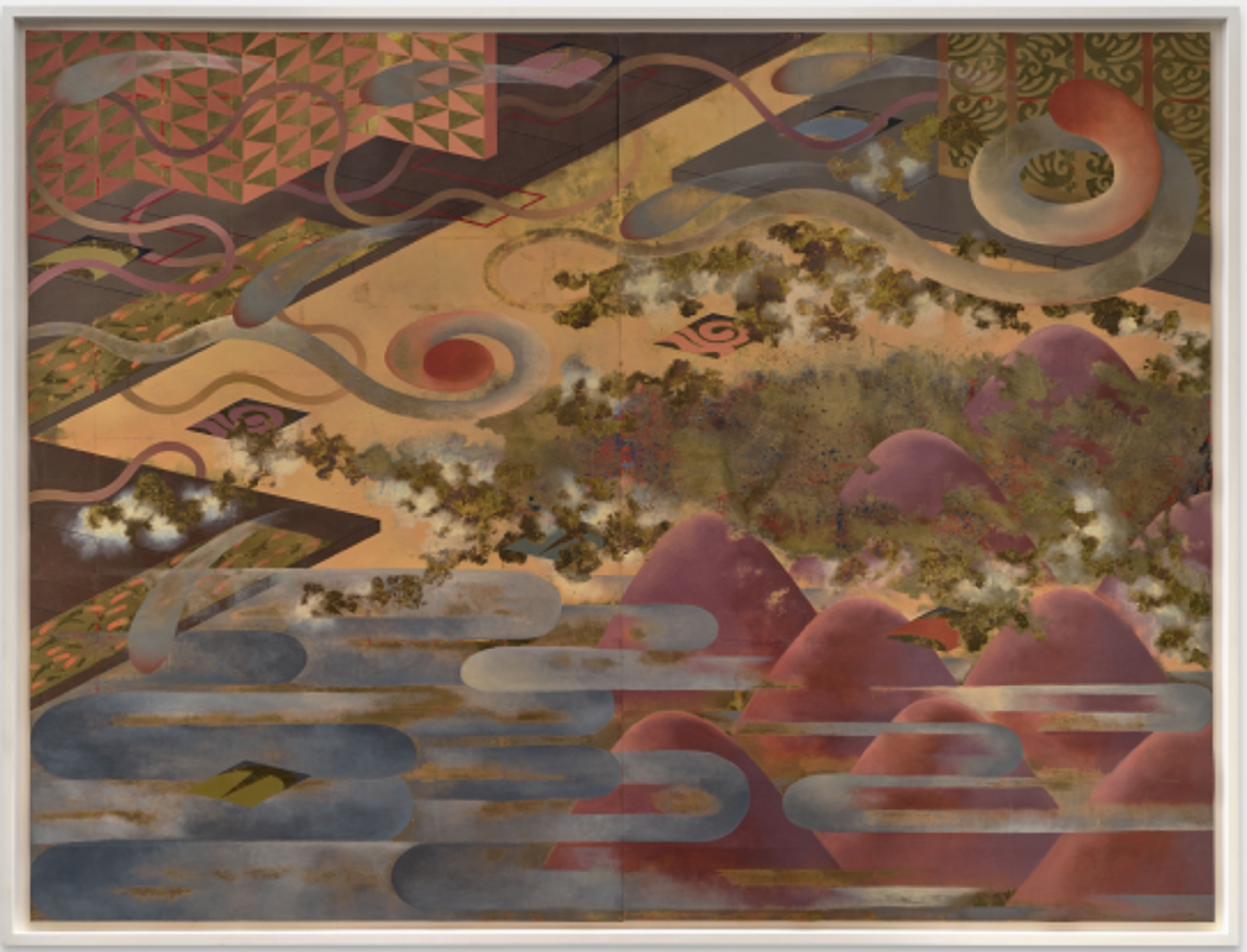
Takako YamaguchiLe Temps Mêle #2
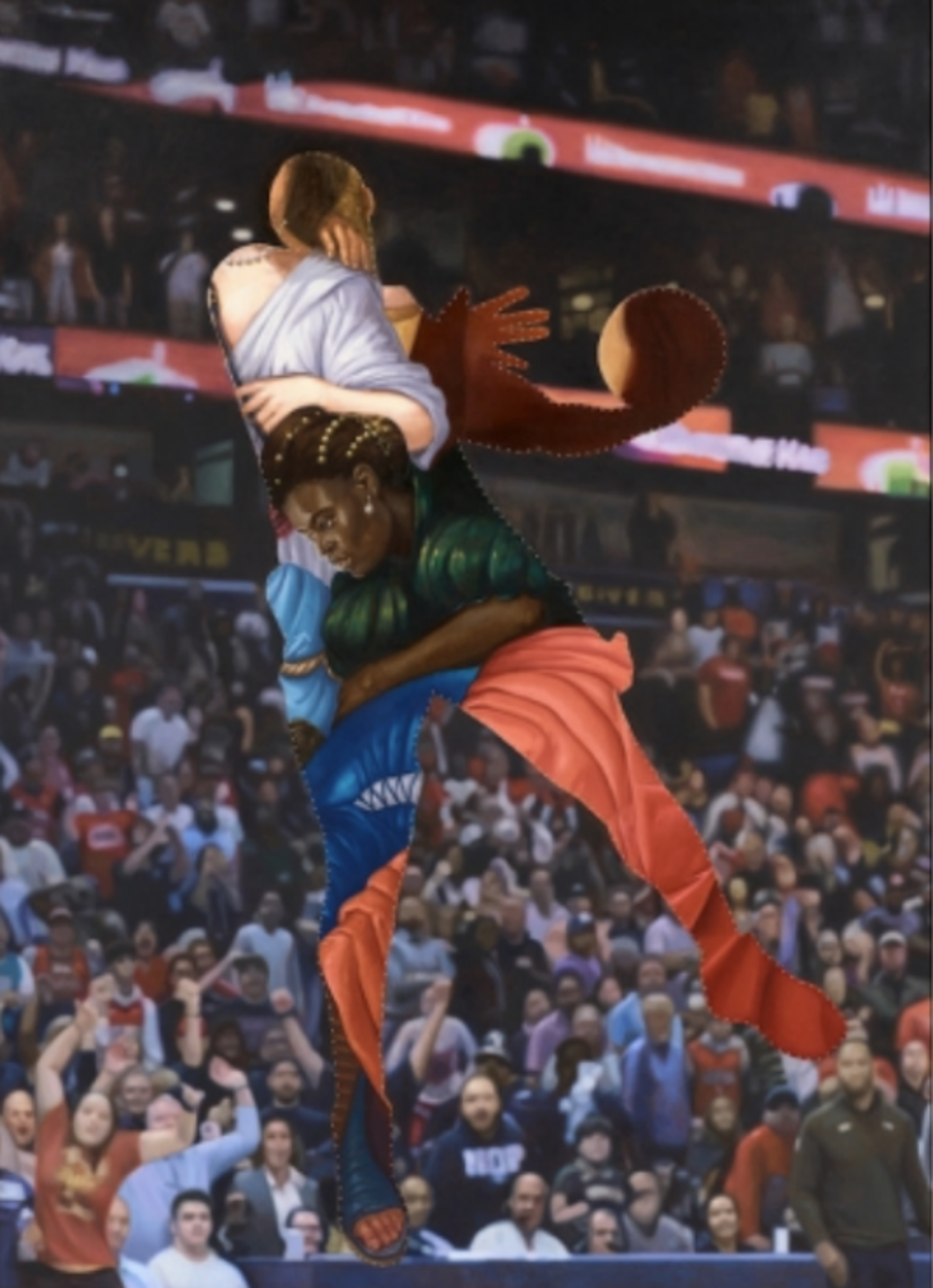
Motown in Motion is based on the history of Paradise Park, a segregated tourist destination in Florida. The “separate, but equal” location was a mile away from Silver Springs, a commercial attraction for white visitors. Despite the systemic oppression at large enacted by Jim Crow laws, Paradise Park was a space of joy and leisure for Black and African American communities, offering beaches, performances, a petting zoo, and more. In this quilted piece, Towns used crystal glass beads and metal buttons to depict the shimmering sky and crackling bonfire. The scene features five beachgoers, who are safe to engage in recreation together, enjoying the water and the warmth of the fire while listening to Motown melodies on a small blue radio.
Stephen Towns
72 x 56 in.
Art Bridges
2024
Natural and synthetic fabric, polyester and cotton thread, crystal glass beads, metal and resin buttons
AB.2025.10
Artist; to Art Bridges, 2025
Stephen Towns Transcript
June 15, 2026
Participants: Stephen Towns (ST), artist; Sarah Myers (SM), Associate Curator, Interpretation; Liz Pollock, Curatorial Intern (LP)
SM: Thanks for being here; we're so excited to talk to you. I wanted to start from the very beginning—what does your research process look like? I know that you do a lot of archival work, particularly for the two [works] we have in our collection, but in general, how do you choose which histories to excavate? What's your relationship to the archives?
ST: It can be sort of random, but a lot of times it has to do with situations that I am dealing with currently in life, or different stories that I read about in the news. I try to examine historical events, historical time periods, or historical figures that can guide me in how to navigate some of the current issues that we're dealing with now. I started this particular work [I Will Follow You My Dear, 2024] during COVID. It was a turbulent time because of the pandemic, but also because of the political situation here in the United States. I wanted to examine how people are able to create rest, how people are able to create safety, and how people are able to create refuge in turbulent times. That led me to the Jim Crow era and to these segregated parks and beaches that existed across the country. It opened me up to the history of amusement parks. I had no idea how prevalent amusement parks were within each little town and city.
This led me to Paradise Park in Ocala, Florida, in Silver Springs. Silver Springs is one of those parks with glass-bottomed boats where you can look at the fish and marine life at the bottom. The boats were captained by Black men but the captain’s families weren't able to attend the park. The captains went to the owners of Silver Springs. It was interesting for me to learn the history of Paradise Park. The founders of Silver Springs hired Eddie Vereen, a longtime boat captain, to manage the park. Vereen cultivated relationships and it grew to be one of the most popular, segregated parks in the United States.
SM: You depict various histories of both Black joy and suffering and hardship. How do you balance the two, and do you see them differently in your practice? Sometimes they're both present; like here, for example, I see joy, but I also see restriction. Could you talk a little bit about that?
ST: I think I'm able to hold the two because I hold the two every day in life. I think as a Black person in America, you always have to hold the two. You have to hold the joy and the frustration or some of the anger. I feel it in my places of work, my places of activity, when I'm going to the store, and in how I interact with people. Also, growing up as a poor person, I had to enjoy the moments of being with my family and the things that we had and not focus on what we didn't have. It's an innate characteristic or tool Black people have to build in America, and so I just was able to use that tool in my work. Before this particular project, I spent a lot of time focusing on pre-Civil War history, which is very complicated. There are lots of tragic stories, but there are also lots of triumphs within those same stories, and I have always had to work with balancing the two.
I have grown as an artist, and as I have been able to show work at more prominent institutions, I've been able to do more workshops and more talks. After each event, there tends to be questions and uncomfortable conversations. I've had people get angry, cry, laugh and have joy. I have learned to navigate all of those emotions when I'm doing workshops and presentations, and I have learned how to gauge the feeling and the spirit in the room. When I have to calm things down, I calm them down. If I need to get the audience to do a breathing exercise, I'll do that sometimes in the middle of a workshop or a program. As an artist and as a presenter, I have had to navigate the duality of life especially in dealing with so many different personalities—people that want to hear the truth, people that don't want to hear the truth, people ignoring things, and so on. I think about those things when I'm making the work. I want the work to be beautiful in a way that people can come into it, but I am also thoughtful in a way that people can question themselves and their own histories.
LP: Pivoting a little bit to think about your influences, how do other artists across a variety of types of art, like music, visual art, and writing—perhaps specifically Black artists—influence your work? I know that the title of this piece [I Will Follow You My Dear], for instance, is drawn from a song, right?
ST: Yeah, so, with those particular two pieces that you have, I listened to a lot of the 1964 Nancy Wilson album, How Glad I Am. The song "I Want To Be With You" inspired the name for I Will Follow You My Dear. I was listening to a lot of albums from that era of the 40s, 50s, and 60s to get a feel of that time period. I would also look at photos for inspiration. Another thing that I have to do when I'm making these pieces is actually search patterns. The only way to tell the colors of the clothing is to actually see the clothing from archives, museums or, historical societies. For those particular pieces, I spent a lot of time looking at sewing patterns to figure out the colors and the patterns that I chose for the bathing suits. I shopped at a lot of different fabric stores to find these patterns. Specifically, with the images of the women, I wanted to make sure that they had a lot of very luxurious patterns. I wanted to complement it well with their particular skin tone.
As a Black person, I think it's important to pay attention to skin tone. In a lot of these images, particularly with the women, I would use dark-skinned women and I would have them being loved and taken care of by a figure, whether it's with themselves, or another friend, or another male. There are a lot of sub-narratives about how Black women and dark-skinned Black women in particular weren’t loved and taken care of, nor seen as beautiful. So I am particular when I'm making this work, specifically quilts, to make sure I'm finding fabric colors, that can convey skin tone of those figures.
SM: The color in both works, but in this work in particular [Motown in Motion], is always what’s drawn my attention. Specifically, the purple clouds. And then also this blue outline that echoes the way the moon shines.
ST: I did a residency in Gettysburg, Pennsylvania. I was there for a month, and every day, my favorite part was to go on top of this hill and look at the sunsets. At the actual site of Gettysburg, they don't have any lights. They try to make it look like it did historically. I would sit on this mountain every evening to see the sunset, and I would see these beautiful cloud formations. Then, after the sun sets, the trees would glow with the retaining light from the sun. That image would always go into my mind, and whenever I'm doing skies, I always think of all those times I spent just sitting, waiting for the sunset in Gettysburg, Pennsylvania.
SM: One thing that connects these two pieces, but also a lot of your practice in general, is light and illumination. They play a big role, both symbolically and literally. In other works of yours, but not these two by subject, you deal very explicitly with religion and spirituality. I wonder if there are any ties to religion or spirituality that you see playing into these pieces through that illumination, light, and iridescence.
ST: Yeah, there actually are. So, I grew up as a Jehovah's Witness. There was always this emphasis on God and the power and glory of God, but there was very little emphasis on the goodness of people. People were always sinners or evil and you always had to look for redemption in God. As an adult that way of thinking no longer worked for me, because for me, all people are imperfectly perfect. They're all spiritual beings trying to emanate God in their own ways, and then we have the world that is emanating all of its energy onto us. That's why I always use luminescent colors, shiny objects, and metal leaf in my paintings, and sparkles, crystals and organza in my quilts. That illumination, the gold in those pieces, references that, for me, God is in everything. It's emanating everywhere, it shines onto you, and you can flow into it. That's why I've always done that in my work. I think about it whenever I'm making the work, and how to make it shiny and gorgeous without it being too gaudy at the same time.
SM: Relatedly, I know that in some of your pieces, the exploration of religion and spirituality also has to do with your own experience with sexuality, and questions and subjects surrounding that. Out of pure curiosity, do you see this as two women or an image of queer love?
ST: So, I didn’t when I was making it, but so many people have said that. I don't want to fight that, if that's what the viewer feels like. I want them to see and feel comfort in that because I had someone talk about that and she said that it made her feel so wonderful to see that image and to interpret it that way. If that's what it is for you, then that's what it is for you.
LP: Where do you source these beads and glass from? What is your process of acquiring them?
ST: So, there's a bead company and convention that travels to different cities around the United States. I would source a lot of beads from there. Now I've found online sites to source them but a lot of times I go to the conventions to get the beads, and then I visit lots of quilting and fabric shops to find high-quality fabrics. I spent a lot of time experimenting with different patterns for this particular series because it was a time period that I didn't explore in previous works. So it took time to gather a lot of fabrics that would work for this particular series.
SM: I love how you layer the different fabrics as well, that it's not just blocks of one color or pattern, but that there are rays of a sheer, iridescent pearl fabric on top of the light blue. I read somewhere that you taught yourself quilting on YouTube and your mother was a seamstress. Do you see your practice of working with fiber arts as related to her relationship to that work?
ST: Yeah, I do. I remember as a child going with her to fabric stores and just paying attention to the buttons and the patterns. When she did that, it would take a long time, but I always found comfort in that space. She also had her sewing machine in her bedroom and so I remember also going and sitting in her bedroom while she was working and watching her lay out patterns over fabric and pinning it and cutting it out. She taught me how to hand-sew, but I never learned to use the machine. I can see how I am picking up skills now that she was doing herself then. Two of my sisters were too. Back in that period in the 80s, a lot of people still made their own clothes, because the process was sometimes cheaper than buying clothes from a JCPenney's or a Sears. The affordable fast fashion that we have now didn't really exist during that time period. They were reliant on making their own dresses.
SM: When you have a subject, how do you decide between painting and quilting?
ST: I think the subject matter tells me that. I'm working on a new series now and was thinking that one piece should be a quilt about a particular person but it's like it's telling me it needs to be a painting. It's sort of intuitive...it lets me know. It's hard to describe as an artist.
LP: What is the historical significance of quilting to you? Why did you turn to quilting, and how might you situate it within other people's studio practices?
ST: Well, my first quilt was called Birth of a Nation, and it's a flag piece. I had tried to figure out how it would look drawn and painted, but it just wasn't working, so I figured I had to sew it. I went back to my mother's house and she still had some fabric in storage, even though she doesn't sew anymore. I started watching YouTube videos, and then I started encountering other quilters and paying attention to the history of quilting. For me, it was about this physical object that you can wrap around yourself to keep you warm. There's also a whole history of quilts bringing together objects from grandparents and parents and sisters and brothers. They are pieces of memory. In the 80s, we couldn't buy clothes and we had to make them. A lot of people also couldn't buy comforters and other covers for warmth. You had to reuse objects, clothing, and different sheets to create these utilitarian objects of warmth and protection.
SM: What is occupying your mind and heart these days? Creatively, emotionally, intellectually...what's got a hold on you?
ST: The survival of this country and what this country will look like in the next 10 years. I question it even more than I have ever before in my life. I think about what I'm learning from history to help inform what I want this country to be like. Right now, I'm focusing on the West and stories of Manifest Destiny, of hope, of resilience, and also of theft. It's another complicated story, and it helps me to understand what this country is now. What we can imagine to be.
SM: Thank you so much for your generosity. It’s been such a pleasure to chat, we’re very grateful for your time.