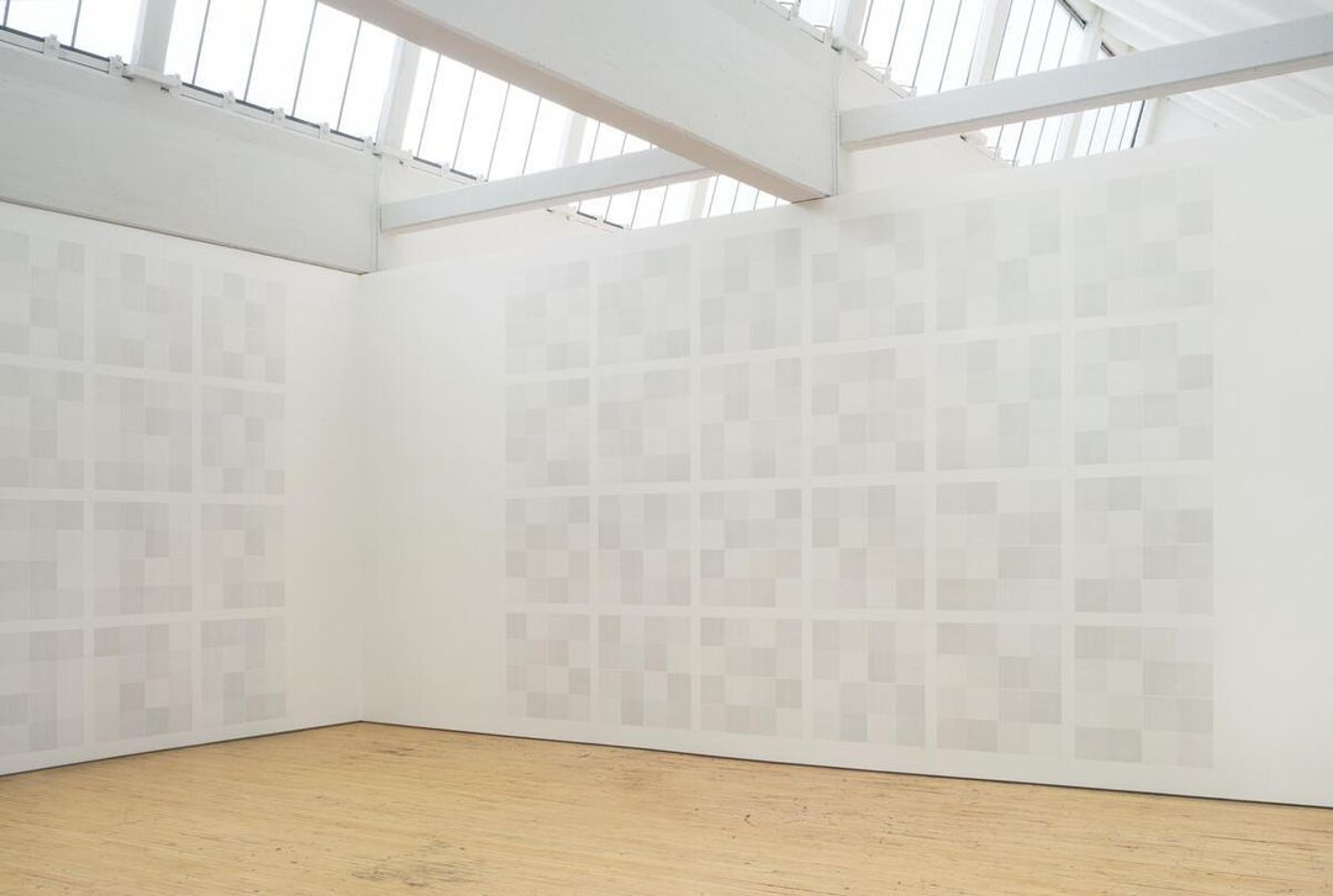
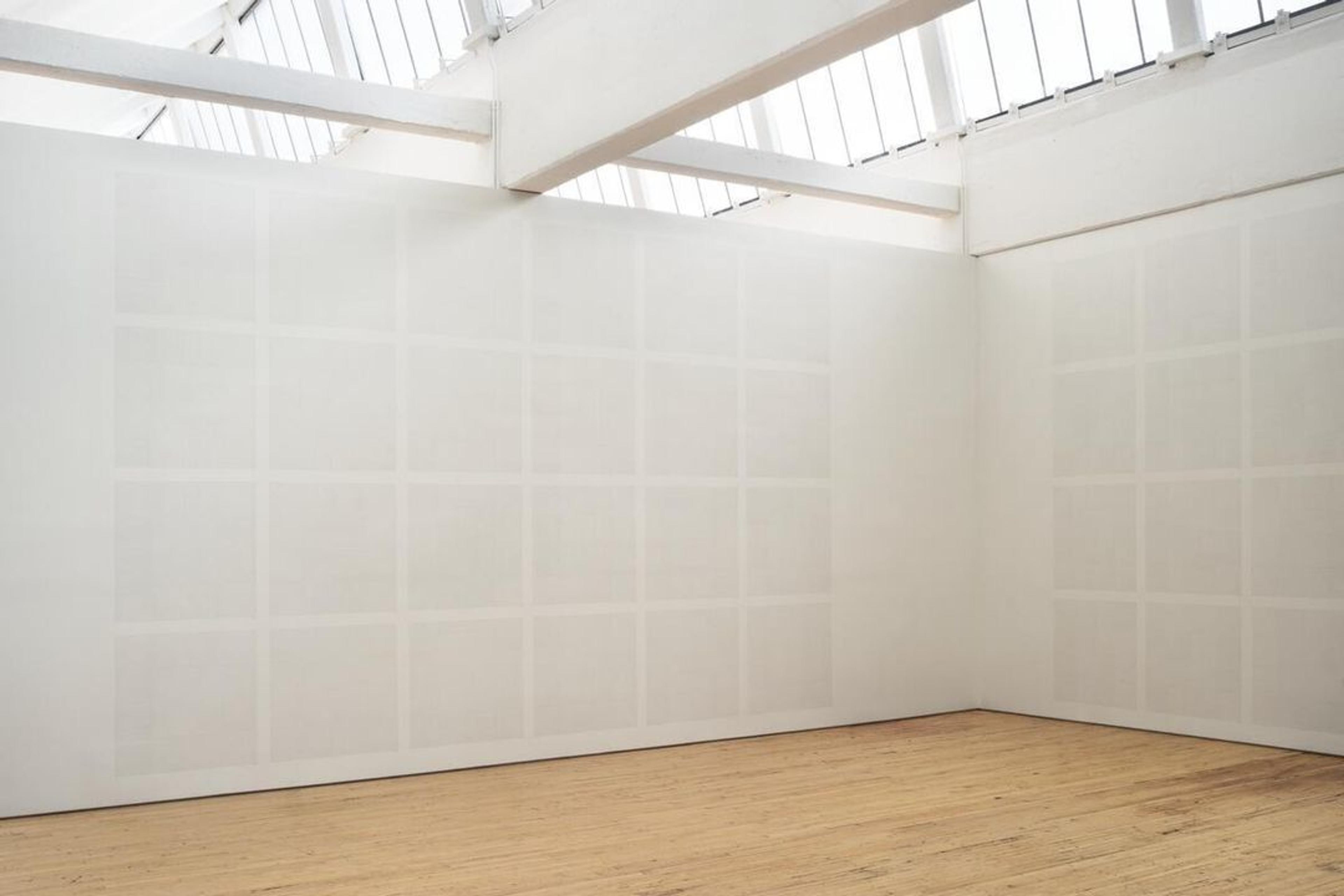
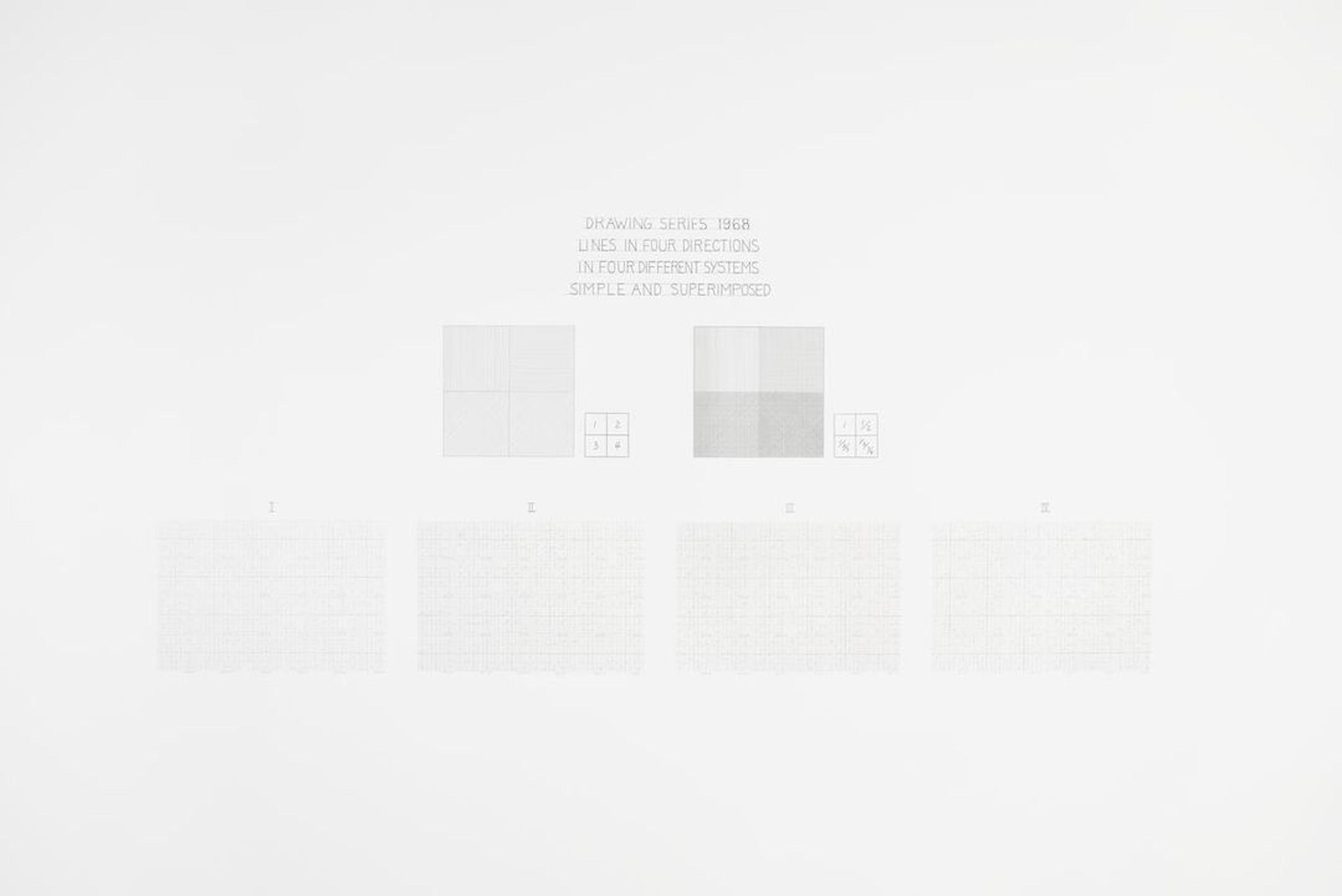
Sol LeWittWall Drawing #1085: Drawing Series–Composite, Part I–IV, #1–24, A+B
In the late 1960s, Sol LeWitt established a set of aesthetic principles through two key texts that would form the basis of his practice: “Paragraphs on Conceptual Art” (1967) and “Sentences on Conceptual Art” (1969). For LeWitt, “The idea or concept is the most important aspect of the work,” and he began to use these ideas as guidelines for two-dimensional works drawn directly on the wall.
When LeWitt executed the first of his wall drawings in 1968, he inaugurated a new genre that he would explore for the next four decades. As with his sculptures and prints, the wall drawings start with a set of instructions to be carried out. The instructions are normally brief and relatively simple—such as “ten thousand straight and ten thousand not straight lines”—while the results vary in complexity and scale. The earliest of these works were drawn by LeWitt himself, but the series quickly evolved into a form of visual score to be interpreted by a qualified assistant or team of assistants at a specific location, analogous to the tradition of musical composition and interpretation.
Wall Drawing #1085: Drawing Series—Composite, Part I–IV, #1–24, A + B was conceived in 1968 but only materialized thirty-five years later at Dia Beacon, where it spanned two large-scale, symmetrical galleries. Despite LeWitt’s firm belief that decisions should be made beforehand, he often capitalized on circumstance. The role of the assisting drafters could be as influential to the piece’s completion as the space itself. Sometimes the physical nature of the drafters, such as their height or arm length, is inevitably incorporated into the work, determining its appearance. Thus, these drawings are always unique, and a single generative principle opens the work to infinite variations.
Excerpted from Sol LeWitt, long-term view at Dia Beacon; Exhibition Information
1-2 years
1
20th Century
Dia Art Foundation
Drawing to be produced on site with the support of Art Bridges and in consultation with Dia Art Foundation.