Jordan Ann CraigCan't Cry Anymore You Laugh
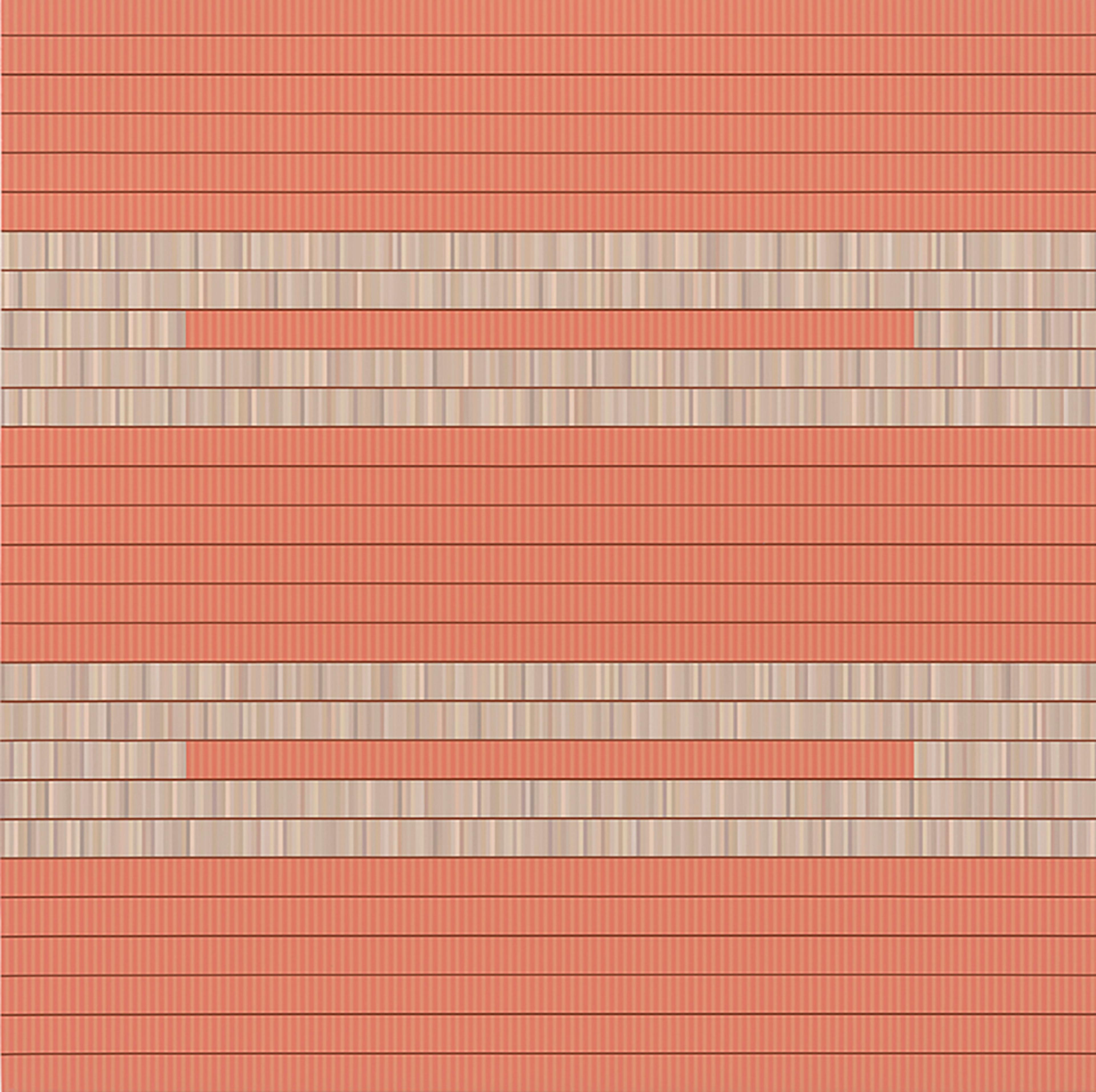
Shonto Begay (Navajo/Diné) renders a quotidian, contemporary scene from the Four Corners region—an area inhabited by Indigenous people for thousands of years that overlaps the modern boundary between Utah, Colorado, Arizona, and New Mexico—through a highly dynamic swirl of multicolored brushstrokes. While it might seem reminiscent of late 19th-century French Post-Impressionism, Begay's distinctive brushwork has an Indigenous origin and is regarded by the artist as the visual manifestation of a language connecting him to the spiritual world. In this canvas, hitchhikers sit in the bed of a truck that features stickers for Navajo Nation elections, riding into a sunlit sky surrounded by the towering sandstone peaks of the region that Begay calls home.
Shonto Begay
48 x 60 in.
Art Bridges
2018
Acrylic on canvas
AB.2025.18
Artist; purchased by Mark Sublette, Tuscon, AZ; purchased by Ron Fash Private Collection; purchased by Corinne Cain, Scottsdale, AZ; purchased by John and Susan Horseman Collection, 2021; (Trotta-Bono Contemporary, LLC, Venice, CA); purchased by Art Bridges, 2025
Shonto Begay Transcript
March 2, 2026
Participants: Shonto Begay (SB), Artist; Sarah Myers (SM), Associate Curator, Interpretation
SM: Thank you for making the time to talk today. I'm just going to walk you through how it's going to go. We have a few questions. I'll start off by asking you to introduce yourself. And as a reminder about the purpose of this: We started an oral history project here at the Art Bridges Foundation, and we are having conversations with living artists represented in our collection to learn more about their practice and the artwork of theirs that we hold in our collection. We'll mostly be talking about Navajo Blue Highway today, but also more generally about your work. Could we start off by having you introduce yourself and sharing anything you'd like from the get-go?
SB: My name is Shonto Begay. I'm a painter. I'm an artist. I'm a writer, and occasionally, I step in front of the camera as well. I am from the Navajo Nation—a small community of Shonto, like my name, in Northern Arizona. That is where I come from. I grew up there, was born and raised there. I went through a series of United States government boarding schools, so I'm also a residential school survivor. All of my work is done through the lens of that, of growing up in that area. Right now, I have my studio and make my living out of Flagstaff, Arizona, which is not too far from where I was born. It's also a place that has special significance for my people, the Navajos, or more correctly, we call ourselves Diné. It’s a special place for us here because of the big mountain. People refer to it as the San Francisco Peaks, but we have a special name for it. Dookó’oslííd is what we call it. That is what brought me here. That's a beacon and an inspiration for a lot of my interpretation of my world for the canvas works.
SM: In Navajo Blue Highway, which is the painting that we have in our collection, can you tell me about the journey that you're depicting here—where these people are going and where they're coming from?
SB: Well, the Navajo Nation, the Diné Bikéyah, is a vast piece of land around the four corners, primarily in Arizona, some in Utah, and New Mexico, so 26,000,000 acres. That is a lot of space for us to travel from one community to another. Roads are very important because they are pretty much what connects us. We don't live in communities. We don't live in villages. We don't have direct access to one another in a lot of cases. To get to trading posts, stores, conveniences, you always have to be on the road—a lot of blue highways—so that's what I tried to pitch here. They're probably going pretty much anywhere, so it's nowhere in particular really. It's just a state of being in motion, in transition. There's always a move; there's always travel; there's always changes. There's always another place beyond the horizon to be discovered. This is what the blue highways represent—that connectiveness. Also, the people you see in the back of the truck, it is just a sense of generosity, of giving each other lifts.
SM: On the right side of the painting, there is this cubic structure. What is that supposed to be?
SB: On a lot of roadsides, there are little businesses, jewelers, and craftspeople. They construct little structures from which they can market their work. In this case, it’s probably a jeweler. A lot of the time, they're seasonal. They use them during warm weather when there's a lot of tourists on the road. We can market our work through them. The blank spaces on the wall provided space for a friend of mine to do some photographic wheat-pasting murals. Chip Thomas, he is a very well-known wheat paster. His murals are all over the roadsides, depicting the people he loves, the people he's been among for a long time. Usually just faces of relatives staring back at you from the side of the road—faces of elders, faces of strong beings. I put that there because it is like an homage to other artists and their roadside businesses. It's not all just landscapes, not all just natural. There are other things that make highways interesting. It’s the people themselves.
SM: Having grown up in this area, does your subject matter largely come from those memories, or does it come from dreams or other things that you visualize?
SB: Well, I guess both dreams and growing up. I visualize it again in my own unrealistic or unconventional way. I work a lot from my memory—all the joys and aches and everything in between: the sense of the wind blowing your hair, traveling down to meet your grandmother, the farm down the road, or going to trade some sheep for school clothing through a trading post, these types of things. Or going down the road to a ceremony to feast, these are the things that keep us together, keep us bonded. It is some memory. It's a mixed lived experience.
SM: I read in an interview when I was preparing for this call that your brushstrokes act as a sort of alphabet inspired by Navajo healing chants. Can you expand on this a little bit? And of course, if there's anything that's culturally sensitive or private that you don't want to share, please omit that.
SB: Okay, well, I grew up in a very powerful hogan, in a sheep camp on a side of Mesa in Northern Arizona. My father was a great medicine man. He was a healer, a chanter, a singer—all to maintain harmony, all to maintain balance of nature, people, and elements. That was his job. His job was like a priest, a doctor, and a kind of counselor. I spent many, many nights, many days sitting through ceremonies, long chants of prayers that may last an hour to two hours. They are lengthy, beautiful poetry. They are all powerful incantations, petitions to the spirit world. So, these are the things I try to replicate in each one of my strokes when I paint. I know these songs because I grew up with them, and they’re deep in my life… very, very much. I carry them with me. I carry that inside of me. So, when I paint, I don't paint to any music or any outside influences. Most of the time, I paint in silence. But in my head, a lot of times, I am replaying ancient songs and prayers that the elders used in healing ceremonies, in sweat lodges, and in other ways. Each one of these prayers is like beautiful poetry. Their chants, I break them up into syllables—syllables to words, words to sentences, and sentences to paragraphs. And I try to use that as a vehicle to keep the strokes going. So, I'd like to think of each one of those strokes as a syllable. For example, in Navajo, when we say, “beauty is restored,” we say, “hózhó náhásdlíí.” So, these are all within the strokes that I create. I use the same line, the same strokes, and circles, spirals… all of those things in every one of my works. It's like an alphabet. It’s like Keith Harings’ subway works; he used the same lines over and over in different compositions to create new images. This is what I'd like to see my work as. I see each one of my works as another ceremony, another healing ceremony, another blessing ceremony performed. So, my work is not just done in a vacuum for purchase, for market because it's pretty. I like to think it's beyond that. It grasps onto the human psyche, the deep psyche, where it connects with the spirit world. And through that, I try to create. It’s a beautiful meditation.
SM: What are the stickers on the back of the car? Do they relate to local elections?
SB: Yes, this was pre-pandemic. We had some politicians running. So, of course, I would put a little sticker for the one I would support. There's one that says, “Nez for president.” Nez is a young man from my community who led the Navajo Nation as its president through the COVID period. He was a very successful crisis president. It was the only nation that flattened the curve at the time. This was through his effort. The other sticker, I don't have the image in front of me, but it’s probably just certain trading posts or ads that you would find on any car.
SM: Is this supposed to be your car?
SB: No, it's just a generic reservation ride. It could be anybody. I don't really have a vehicle like that, but I've sat in the back of many, going down the road.
SM: Could you tell me a little bit about your career illustrating children's books and working for newspapers?
SB: In the late ‘80s and 1990s, and still to this day, I do a lot of children’s books’ illustrations. I did many books for Scholastic publishing, for Putnam. Lately, it’s been Simon & Schuster, Random House. I’ve done a couple of illustrations for them. And on top of the trade books, I also did a bunch of instructional materials for schools, various instructional publishing houses, re-illustrated things like tall tales. I illustrated the poetry of Walt Whitman. And of course, one of the stories I illustrated was Scott O'Dell’s Island of the Blue Dolphins some years ago. I did a lot of that. I still do it, not as much anymore, but I enjoy it. I did a lot of book tours in the early 1990s, signing books, and two of the books that I did for Scholastic, I authored as well. Even the paintings I do now are pretty much illustrations, and that carried over into having my own column in a local paper in Flagstaff. Our entertainment paper has all the things happening that week in town, and I had a column in there called Letters from Home, which pretty much allowed me to talk about anything under the sun. I talked about everything except religion and politics. I talked a lot about growing up the way I did, what influenced me, where I came from, and how I see the world. So, I did that weekly, like 1,200 words. I really enjoyed that. I haven't done that since 2012, but I enjoyed doing that for 10 years.
SM: I read that you also came from a family of weavers and that your father, as you said before, was a medicine man. I understand how your father influenced your work and your approach. Has weaving also come into the way that you paint or inspired it?
SB: Oh yeah, very much so. In the Navajo stories and in the Navajo legends, weaving came as a gift from Spider Woman. The spider is a very sacred animal and a patron to the arts. The amount of work I have seen my mother and my grandmother put into each rug—how dedicated they were to their pattern, how the design flows freely from their fingertips, where the design represented the holy world, the holy beings, how beautifully it was composed with natural dyes—that was just amazing. How did they do that? How did they keep lines so straight? How do they keep every design so perfect? When the women weave (men too), there's only the little line that is taken from the design itself and leads outward toward the edge of the rug. That's what we call a spirit break. The spirit break allows your very intense concentration and deliberate sense of interpreting powerful things. It allows you to let that out, give it a little way out, release it, and keep releasing it, so it will feed into other wonderful work that you will do later. In the stories, when you close that spirit break, when you don't carry them, when you don't put them into your work, it is said that you are stuck in that one piece of work. You can't progress. So, in my work, I have a spirit break somewhere. I don't try to make everything so perfect.
I grew up in a hogan with the constant sound of weaving—a thump, thump, thump all day. When I was home, I was always sitting at the feet of the loom. My mother was weaving, or my aunt or my grandmother was weaving, and stories were told. Later on, I read them storybooks and interpreted them because they didn't speak or write English. So that's how I grew up. I grew up among weavers. It also allowed me to see the gift of Spider Woman... the gift of that art, how they provided for the welfare of the family, of the clan, of the extended family. You know, this was how they brought about a livelihood. So, I treat it with respect in that way as well. That is why, to this day, some of the most sacred elements that are out there in what we know as Navajo art, like in sand paintings, like in Yéʼii Bicheii, Yéʼii images, the spirit images, I stay away from it. I don't do that because I respect that too much. I respect that because the very first artwork I did was for healing. I was an accidental fourth person, hunched over creating a sand painting mandala because the old gentleman got sick and couldn't show up. So, there was an emergency. Somebody said there's a kid in the sheep camp who can draw, so they enlisted me. I hunched over, and I did all those lines with the earth's color and replicated the ancient template that you can't deviate from. And the medicine man is chanting, and the fourth, me, and the old guys are sitting, hunched over, painting for about an hour or so. You know, just beautiful. And you can feel the holy sacredness of the whole performance. You can feel everything is magical, powerful in the form of sand, colored sand coming through your fingertips. So, this is what I grew up doing. That's the very first artwork I did. To this day, all the artwork I’ve done still has that element of respect and healing.
SM: How old were you when you did that?
SB: I was about 6 years old.
SM: Very young.
SB: Yeah.
SM: I'm curious what is on your mind these days as an artist... questions that you're working through, whatever you're thinking about in your artwork...
SB: Well, I'm just constantly documenting my life. I think about what I am leaving to this generation. What am I leaving as a legacy? I don't want to just make pretty landscapes. I want something that has, you know, solidity and longevity. I want something that holds the same power 100 years from now. And also, to document. I've importantly documented the time span I grew up in—the 1950s and ‘60s as a young man, as a young kid. That’s a kind of treasure I remember that will never be again. Times are changing, my people, everybody's changing, everything is, the world is changing fast. So, I'm grasping for that. I'm hanging on to that. That's why I'm very challenged technically these days. I'm totally still analog in every way. I don't release my work to the public unless I like it. Not everything I do goes on the market. Many of them are held back because they have too much of a special connection to my own family, my own being. So, what do I think about? I think about the future. I think about how lasting it is, how lasting it will be, and how lasting I want it to be.
SM: That's beautiful. Thank you.